|
Welcome to pfli.org, the only website serving the profession of pharmacy as a totally 100% pro-life philosophy! All the pro-life pharmacy news and information that is fit to print
and that the "drive-by" pharmacy media choose to ignore or misreport.
"The Pharmacists for Life International site, for example, in addition to having an incredibly sophisticated web design...."
--radically bigoted and intolerant abortoholic website, "Feministing", accessed 16 Jun 2008 AD...thanks, girls!
Donate and Sign Conscience PetitionToday
|

|
|
News and Content |
|
Plan
B [Emergency Abortion Pill] FAQs
"Morning After Pill" Primer by Peggy Pace, RPh, BS Pharm
Oral
[so-called] "Contraceptives" FAQs: a Pill you may not want
to swallow
Q:
Is Plan B an abortifacient drug or a contraceptive?
A:
[PFLI Note: Numerous studies support the notion that the high dose, high powered
steroid(s) found in Emergency Abortion drugs like Plan B are
abortifacient 75 to 89% of the time, as reported in the Medical Letter and from FDA data.] Rarely will a drug like Plan B
and similar generics work to suppress ovulation and truly prevent the meeting of the male
and female gametes PRIOR to the moment of conception.
Q:
Who is able to purchase Plan B OTC?
A:
At present, men of any age and women age 15 and older may purchase Plan B OTC . It is very
possible a sexual predator could buy Plan B to cover up and hide one
or numerous instances of underage statutory rape or incest. This current FDA policy
is be contested in a variety of lawsuits before Judge Edward Korman of NYC and the
O'Bama Regime. PFLI's policy is to oppose drugs like Plan B because they are chiefly abortifacients,
can be used to cover up crimes of rape, incest and sexual slavery; and have long term negative
consquences that are not well studied in young women. Other similar high dose steroids
have been shown to have serious health dangers for women up to and including stroke, heart attack, various cancers
and death.
Q:
Where can patients obtain Plan B OTC in the pharmacy?
A:
At present, patients may obtain Plan B OTC at the pharmacy counter; it can also
be bought OTC where it is so stocked. Plan
B OTC may not be available in places that do not have a licensed
pharmacist or prescriber at the facility (i.e. gas stations,
convenience stores, food marts, etc.).
Q:
Can patients obtain Plan B OTC at other healthcare facilities such
as clinics?
A:
Yes. Plan B OTC may be available at other healthcare facilities such
as clinics.
Q:
Who can sell Plan B OTC?
A:
The Food and Drug Administration (FDA) mandates that a healthcare
professional (e.g. pharmacist or prescriber) be available to answer
questions or address any concerns that the patient may have about
Plan B OTC. Individual pharmacy practice will determine which staff
members (e.g. pharmacists, pharmacy technicians, student
pharmacists) will be allowed to sell the medication. It is possible
an unqualified non-licensed staff member may end up dispensing this
potent abortifacient steroid without any knowledge of medical or
drug history and conditions of the end user. Currently OTC and/or
Rx placement is being contested in various courts [as of 5/10/13].
Q:
What kind of proof of age will be required for consumers 15 and
older to purchase Plan B OTC?
A:
The FDA has not issued specific guidelines regarding proof of age.
However, the Drug Enforcement Administration (DEA) recently
published a list of acceptable forms of ID for another drug product.
Pharmacies may decide to follow these same guidelines, which include
driver’s licenses, passports, and school ID’s. The
complete DEA list is provided at the end of this document.
Q:
How will the age restriction be monitored and enforced?
A:
No known monitoring of age is uniformly in place in all states.
Pharmacists
of conscience are encouraged to monitor area pharmacies and to
report instances of non-compliance to their respective board of
pharmacy and/or the FDA.
Q:
Can states place additional restrictions on access to Plan B OTC?
A:
It is possible and very liekly. Many states have enacted statutes to
prohibit the sale of medications that have an abuse potential or
that are harmful to the health of the patient. As well some states,
based on the recent scandal of Planned Parenthood centers not
reporting cases of statutory rape and incest in KS, IN and OH, may
lead to more restriction to protect underage girls from sexual
predators. It is too early to know whether the states will use this
authority.
Q:
Will the switch impact pharmacist’s prescribing authority that
currently exists in certain states?
A:
The product’s dual-status will not impact collaborative
agreements in the states that provide pharmacists prescriptive
authority for emergency contraception. Patients under 15 in these
states will continue to be able to access Plan B from pharmacists
who have this authority to prescribe and dispense Plan B. Patients
15 or older will be able to purchase Plan B OTC. Check with your
state laws and regulations through your state board of pharmacy for
any additional requirements.
Q:
When will the OTC version of Plan B become available?
A:
Reports indicate that the first shipments of Plan B OTC were sent to
distributors the first of November and are currently in circulation.
Q:
Will the labeling on the new version differ from the Rx version?
A:
At present, the prescription (Rx) version will be replaced by a dual
label (Rx/OTC) version. It will include a drug facts section and a
patient brochure; it will also have the statement “Rx for age
15 and younger” imprinted on the packaging.
Q:
Are there quantity limits or registration procedures required for
purchase?
A:
No. The FDA has not specified any quantity limits or registration
procedures. Systems to document that the pharmacy has checked the
patient’s age may be established by each individual pharmacy.
Q:
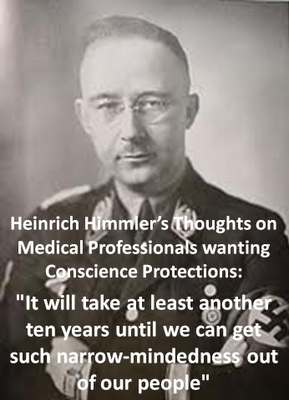
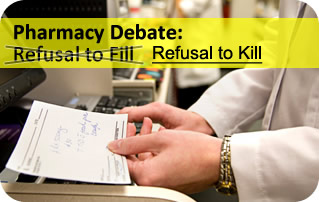
Can I invoke my rights of conscience when Plan B OTC is requested?
A:
PFLI fully supports an individual pharmacist’s ability to
choose not to dispense or counsel with respect to a medication for
personal, religious and moral reasons PFLI also encourages
pharmacists with objections to dispensing any medications, including
Plan B OTC, should work with their management to protect their
rights of conscience in advance, preferably in writing. A simple way
to deal with this product is simply not to ever stock it, if
possible. For employee pharmacists with a conscience, this may prove
difficult, as corporate policy may allow or even mandate stocking
Plan B.
Q:
Where can I get more information?
A:
PFLI has several resources on line at:
http://www.pfli.org/main.php?pfli=kemikalkill
Updated: 13 May 2013 AD
|

|



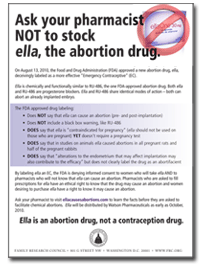
 ASK YOUR PHARMACIST TO NOT STOCK ELLA...